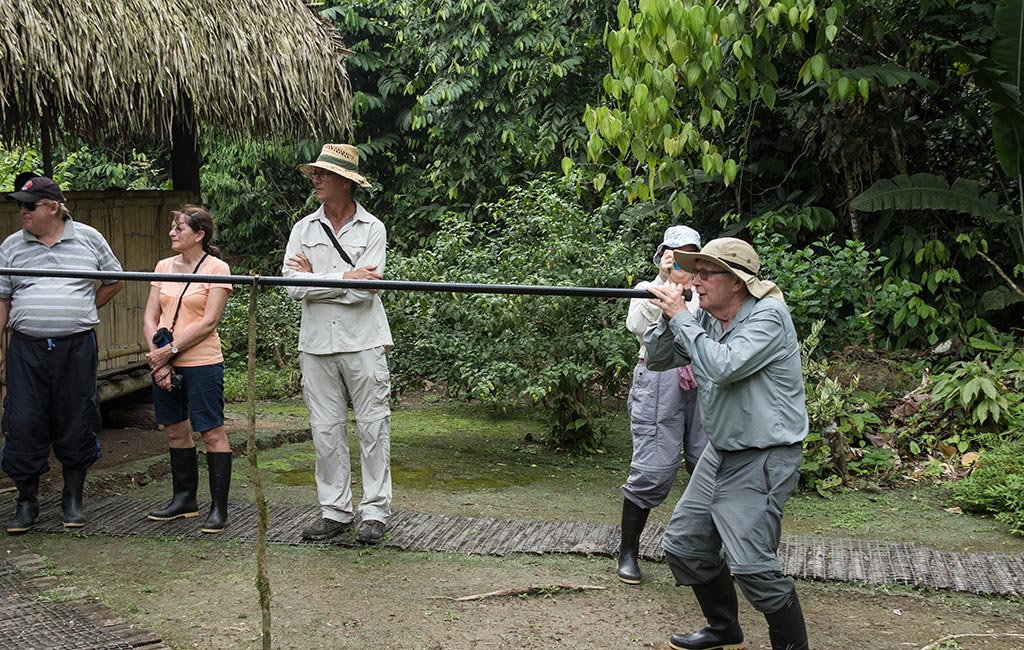
We are back in the field! Thanks to the support of Sacha Lodge for the primatological research conducted by faculty and students of Universidad San Francisco de Quito, we have begun a new phase of our study to assess how climate- driven changes in food availability and pathogens may affect pygmy marmoset’s behavior and population dynamics. We hope our results will contribute to understanding the drivers of the severe population declines of this species, the Northern pygmy marmoset, reported in Amazonian Ecuador in the last decade.
The family of pygmy marmosets we are studying now is quite large: 12 marmosets, including one infant born about two months ago. The regulations established by Sacha Lodge to prevent too many people from getting too close to the monkeys are key to minimizing the stress that human presence could cause, ensuring marmosets’ well-being.
The power of communication
In the second week of field research, we recorded a very interesting and unique behavior! On two occasions in one day, about five marmosets gathered around a small tree in their territory and moved close to the ground, looking at a specific spot in the leaf litter while emitting frequent and very loud alarm calls for several minutes. In our long-term study of pygmy marmosets, we have recorded this behavior only when they detected a snake, usually a boa. Although this time we were not able to find the snake, it is possible that it was hidden and camouflaged in the leaf litter. The fact that pygmy marmosets emit a specific type of alarm call and perform these particular behaviors when observing a snake suggests this alarm type may be a functionally referential call, meaning that it is consistently linked to a specific external stimulus and elicits specific behavioral responses in other marmosets. This is just a snapshot of the complexity of their vocal communication system.
Pygmy marmoset family dynamics
Keeping track of all the marmosets in a large family group is challenging. Marmosets in such large families tend to gather in small parties that occupy different areas of the territory. Usually, subadults are found on the periphery and may occasionally venture outside the territory boundaries, whereas the reproductive pair and their youngest offspring stay close to the main feeding tree. Each party also uses different pathways to travel to and from the sleeping tree, the only place where the entire group stays together at night. This is why it took us time to confirm that our study family split some days ago.
Now, the family has eight pygmy marmosets, including two new-born infants! We don’t know where the other five marmosets are, but with the help of the guides at Sacha Lodge, we are looking for them. We hope they will find a good area to settle and form a new family group. Meanwhile, we continue studying the marmosets of the core family, recording their feeding behavior and social interactions like grooming and play, and remaining awed by their fascinating behavioral complexity.
Seasonal changes
By studying the family group in the rainy and dry seasons we are beginning to understand how climate variables may affect the availability of plant exudates (gum) and insects, the two main food sources of pygmy marmosets, and how these intelligent monkeys may cope with these changes. Changes in time spent feeding on exudates, along with the use of new foraging techniques and new exudate trees, provide evidence of how pygmy marmoset are using their behavioral plasticity to survive in an ever-changing world. We are looking forward to our next field period with the pygmy marmosets at Sacha Lodge, to learn more about their fascinating behaviors and to find ways to better protect them.